
Click Here to Read the Full Version
Happy New Year to all our readers.
The weekend’s events not withstanding, risk assets enter 2026 with confidence and momentum, not blind optimism. Sentiment appears constructive, not euphoric, and that distinction matters. Markets ended 2025 on a high, underpinned by steady growth and inflation that remains largely contained. The key difference between what we see now and much of the post-pandemic cycle is that any further significant monetary easing is largely absent from the near-term outlook. Early gains in 2026 will therefore need to be earned rather than gifted. If corporate reporting indicates consistent revenues, resilient margins, and modest earnings beats, a broad rally in risk assets, particularly in the US, could occur in the first quarter. Equity markets may not require perfection; merely a confirmation that growth is not deteriorating should be enough to lift sentiments.
The remainder of the year is more finely poised. Without policy tailwinds, returns depend on three things: Growth first. Inflation behaving. Rate cuts only at the margin. Markets will respect that order.
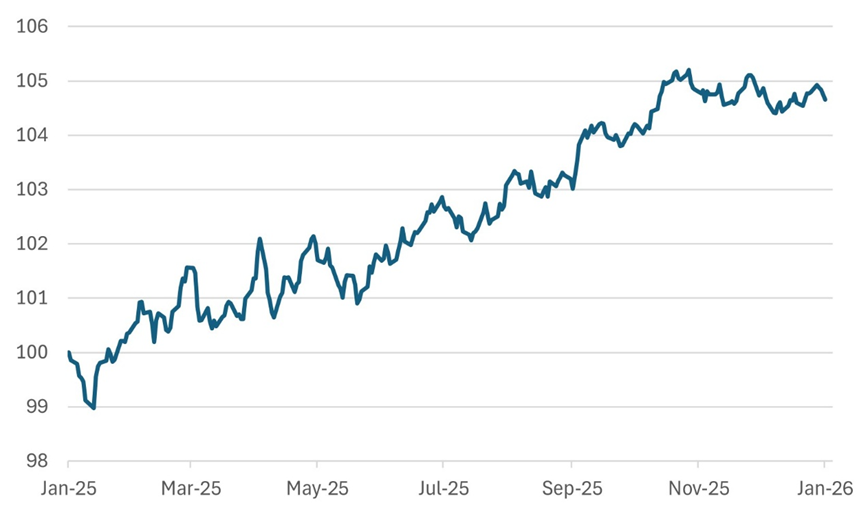
Government bonds are likely to have a muted outlook in the absence of economic stress. Bond returns in 2025 were respectable in real terms but unremarkable relative to equities, and 2026 could see returns gravitate towards the running yield in a world where core sovereign yields are clustered broadly in the 3-5% range. High debt-to-GDP ratios across developed markets are a pressing concern, placing upward pressure on term premia and limiting the scope for sustained bond rallies. In some cases, governments are struggling to bring deficits under control, as in France; in others, markets appear willing to tolerate a degree of benign neglect, as in the United States. Bonds remain relevant for income and portfolio stability, but risk and return expectations need to be firmly grounded.
Chart 1: Global Aggregate Bond Index Struggling to Generate Return
rebased to -1Y =100
Source: Bloomberg
One of the most significant risks to markets sits not in growth data but in how institutional credibility is perceived. The impending change in leadership at the Federal Reserve carries the risk of a perception, fair or otherwise, that the policy independence of such institutions is being diluted. With lingering inflation uncertainty, any sense that monetary policy is being pushed too far, too soon could lead to a sharp uptick in long-dated yields. In those circumstances, markets would respond not by cheering easier policy, but by demanding a higher risk premium. A move in the US 10-year yield towards 4.5% could challenge equity markets, particularly the US, where valuations remain elevated and tolerance for higher discount rates is limited. Earnings may hold up, yet multiples need not.
Chart 2: Basis points steepness of the US Yield Curve 10-year less 2-year

Source: Bloomberg
Alongside this, we continue to see a gradual and rational flow of capital from West to East. Japan, Korea, India and China all enter 2026 on more reasonable valuations, with policy flexibility that is increasingly scarce in the US. Lower oil prices and a softer dollar bias support this shift, while Asia’s growth dynamics, particularly in India, remain compelling when viewed through a longer-term lens. Capital rarely moves because it is invited; it moves because it is better treated. Markets discount the future, and India’s combination of demographics, formalisation and a still-emerging consumer class remains one of the most attractive long-duration growth stories globally. China’s heavy investment in technology and green infrastructure continues to shape its future competitiveness, irrespective of short-term sentiment swings. Structural changes in Japan and Korea are reshaping market dynamics and investor perceptions.
Chart 3: MSCI US loses out to MSCI EAFE – relative performance of US equities to World ex US.

Source: Bloomberg
Note: MSCI EAFE = MSCI Europe, Australia and Far East
Still room for technology – but not without its risks
Technology continues to attract significant investor interest, though risks are increasingly concentrated outside listed market leaders. Valuations in the listed market for leading technology companies are still defensible relative to expected corporate profits growth rates. The vulnerability sits in liquidity across the wider ecosystem. The scale of capital deployed into private technology, AI ventures and tech related private credit means that it would take little to trigger a sharp reassessment. McKinsey estimates global data-centre capex needs could reach $6.7tn by 2030, with $5.2tn of that for AI-capable data centres. OpenAI sits at the epicentre of this ecosystem and must continue to raise capital as data-centre infrastructure scales. A failed or delayed funding round, for any reason, could have meaningful consequences for the sector.
Commodities are reasserting their role in portfolios.
Precious metals continue to offer reassurance in a world marked by geopolitical strain and institutional uncertainty, and further potential upside in gold and silver remains plausible. Beyond that, strategic commodities such as copper are benefiting from competition for supply driven by electrification, data infrastructure and energy transition policies.
Chart 4: General Commodities lag Gold
Gold and GSCI equally weighted Index rebased to 100

Source: Bloomberg
In an increasingly multipolar world where different blocs of buyers compete for access to crucial commodities spikes higher in commodity prices are likely to become the norm. A broad range of commodities increasingly look strategic rather than cyclical. In portfolio terms, this is less about inflation hedging and more about strategic optionality, and allocations are likely to rise meaningfully from past norms. Four decades ago, commodities often accounted for around 15% of global portfolios.
Absolute return over bonds
Absolute return strategies continue to be discussed favourably by some market participants in an environment of constrained bond returns and elevated volatility. While some sources of easy alpha for hedge funds have faded (such as duration bets), a well-constructed absolute return allocation targeting high single-digit to low double-digit returns.
Risks to this view lie in the interaction of several adverse outcomes rather than any single shock. A renewed inflation surge, a loss of Fed credibility, earnings disappointment driven by margin pressure, a liquidity event in technology or private markets, or a geopolitical disruption to energy or commodity supply chains could combine to produce a more volatile and uneven market outcome. None of these risks alone would necessarily derail markets, but together they would challenge the expectation of a constructive start to 2026 and reinforce the need for portfolios built for uncertainty rather than precision as the year unfolds.
Gary Dugan – Investment Committee Member
Bill O’Neill – Non-Executive Director & Investor Committee Chairman
5th January 2026
The information contained within is for educational and informational purposes ONLY. It is not intended nor should it be considered an invitation or inducement to buy or sell a security or securities noted within nor should it be viewed as a communication intended to persuade or incite you to buy or sell security or securities noted within. Any commentary provided is the opinion of the author and should not be considered a personalised recommendation. The information contained within should not be a person’s sole basis for making an investment decision. Please contact your financial professional at Falco Private Wealth before making an investment decision. Falco Private Wealth are Authorised and Regulated by the Financial Conduct Authority. Registered in England: 11073543 at Millhouse, 32-38 East Street, Rochford, Essex SS4 1DB