
Click Here to Read the Full Version
Summary in plain terms: Stock markets are near all-time highs, but the economic backdrop is quietly getting worse. Growth is slowing while inflation is showing signs of becoming more persistent. Commentators have noted increased interest in technology and energy sectors, while questions are being raised about the outlook for longer-dated government bonds. The broader theme in current market discussion is whether inflation will prove harder to contain than is currently priced in.
The overarching theme this week is simple: economic growth is slowing down even before inflation has fully laid bare its tentacles. That chronology matters. The data that tracks how often economic numbers surprise to the upside has turned negative on growth, even as inflation surprises begin to unnerve all and sundry. Markets, meanwhile, are holding up because company earnings are strong, spending on AI infrastructure continues to accelerate, and the Fed chair’s decision to stay on at the central bank board removes one source of uncertainty. But the underlying economic picture is worse than the recent performance of stock markets would suggest, and the inflation story has a real-world, physical dimension that financial markets are still not fully pricing in.
Jerome Powell deciding to remain on the Federal Reserve Board even as the chairmanship changes hands reduces one key overhang: the risk of a sharp, unpredictable shift in how the US manages interest rates. That is the positive read. The negative is that it also means there is no near-term pivot toward lower rates. The Fed is still dealing with inflation that remains above its 2% target, a jobs market that has not weakened, oil prices that remain elevated, and the cost of tariffs that are now visibly feeding through into prices. The ISM manufacturing survey made that abundantly clear. The headline index held in expansion territory at 52.7 in April (anything above 50 signals growth), but the prices-paid component, which measures what factories are paying for inputs, moved to a four-year high. The market wants the Fed to ease, but the data is not cooperating. And, in our view, it is going to get worse before it gets better.
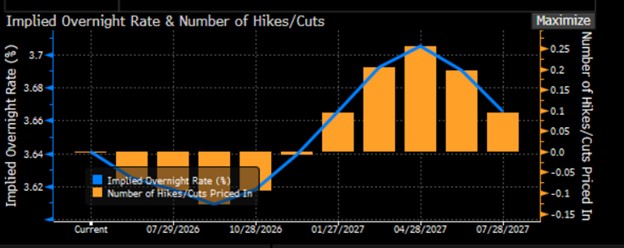
Chart 1: Global Economic Surprise Indices – Inflation and Growth
Source: Bloomberg
The US economy grew at a 2.0% annualised rate (ar) in the first quarter of 2026. AI-related business investment and a rebound in government spending did most of the lifting. Consumer spending slowed to a 1.6% ar in the quarter. The household savings rate fell to 3.6%, the lowest in three-and-a-half years, meaning people are saving less and spending more to maintain their standard of living.
Business investment in computers and related equipment was up an impressive 64% compared with the same quarter a year earlier, and broader non-residential investment rose 10.4% over the same period. That contributed 1.4 percentage points to the quarterly annualised growth figure. AI spending and government outlays effectively accounted for all of the quarter’s growth. That is a real boom but it is not a broad one.
The importance of that concentration cannot be overstated. AI infrastructure has moved beyond being a stock market theme, and it is now propping up the overall growth numbers. The four major tech companies building out AI are on track to spend close to $700 billion on AI-related infrastructure this year. However, it also means the economy is now unusually dependent on this one cycle continuing. If AI spending pauses, slows, or disappoints on the returns it generates, the overall growth picture will deteriorate rapidly.
Household spending is still growing but it is being funded with reduced financial buffer. A savings rate of 3.6% is not ideal or, rather uncomfortable, when fuel costs are rising, tariffs are pushing up the price of everyday goods, and consumer confidence is weak. Retail inventories, the stock of goods sitting in warehouses before they reach stores, came in above expectations. On paper, that can look like strength, but in the current environment, it more likely means businesses pulled goods forward ahead of tariff-related supply disruption. If shoppers pull back on purchases, those inventories become a problem rather than a cushion.
Europe deserves a detailed analysis because of the prevailing dynamic there, which, if anything, is more uncomfortable than the US. Growth across the eurozone remains weak. Germany, the bloc’s largest economy, has barely avoided consecutive quarters of contraction. Industrial output is stagnant and consumer demand remains subdued. The European Central Bank has been cutting rates to support growth, but inflation has been a bit of a spoiler. Services inflation remain sticky, energy costs are feeding back into what businesses pay for inputs, and the same fertiliser and food cost pressures building globally are showing up in European producer prices, what factories charge before goods reach the consumer.
The result is a central bank caught between an economy that needs cheaper borrowing costs and a price level that does not justify them. What complicates the problem for Europe is it has less room to stimulate through government spending than the US, no equivalent AI capex boom that can act as a growth stabiliser, and its significantly higher exposure to energy supply disruption given how dependent the continent is on imported energy. If the Strait stays closed and physical oil prices remain elevated, Europe faces a harder version of the same trap, sluggish demand with supply-driven inflation that rate policy cannot easily fix without making growth worse.
US company results for the first quarter have been strong. With more than 60% of S&P 500 companies having already reported, earnings growth is running at around 15.1% compared with a year earlier. Profit margins are at 13.4%, the highest level in data going back to 2009. More than 80% of the companies have beaten both earnings and revenue expectations. Among the large tech names, Microsoft, Alphabet, Amazon, and Apple all reinforced the AI and cloud spending story. Meta was the exception, it guided to higher spending alongside signs of softness in user growth.
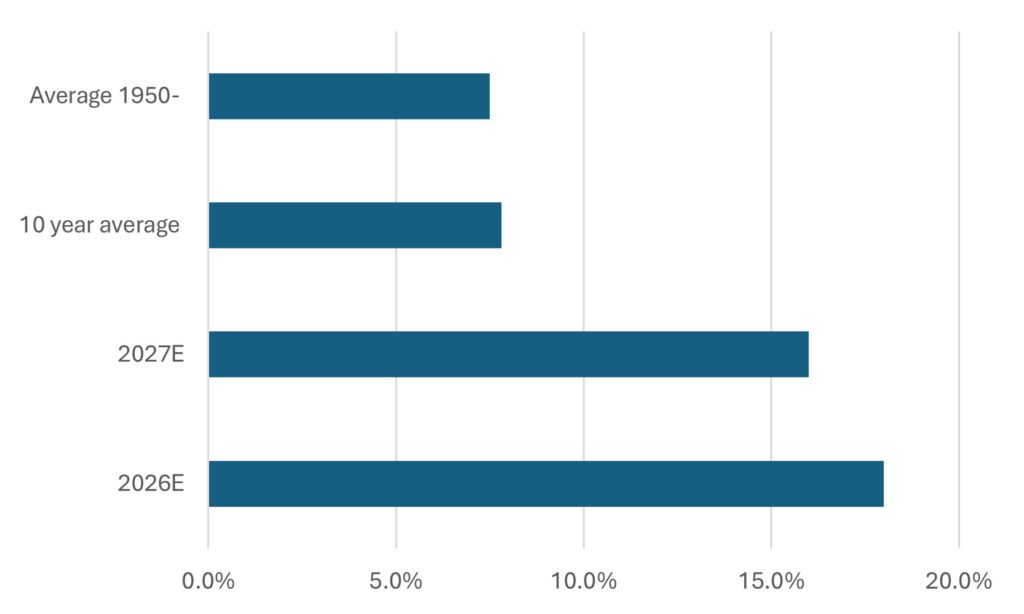
Nevertheless, the strong earnings season is why stock markets have held near record highs, even as oil prices remain elevated and geopolitical risks continue to unravel. But expectations have now fully priced in the good news. Consensus forecasts are effectively assuming that margins will stay near record levels and that AI spending will continue to broaden. The historical parallel is worth keeping in mind: very strong earnings growth is typically a positive signal after a recession, when profits are recovering from a low base. Outside that setup, strong earnings and confident forecasts have often appeared close to market peaks. The comparisons – 1929, 1973, 2000, 2007 – are not a prediction of a crash. They are a reminder that markets become more fragile when margins are already stretched and analysts are raising forecasts into a deteriorating backdrop.
Chart 2: Consensus Expectations for US Corporate Profits Growth vs. History
Source: Bloomberg
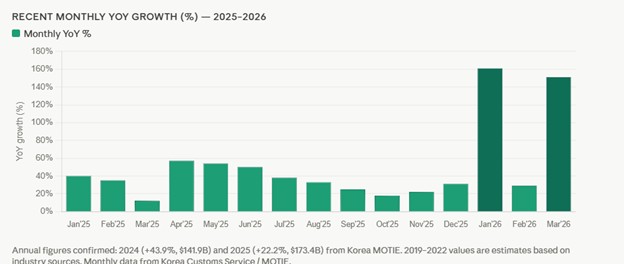
Korea is worth highlighting because its exports figures provide one of the clearest global readings on where the AI cycle sits. Exports rose 48% in April compared with a year ago. Semiconductor exports were up 173% year on year; computer-related exports were up a staggering 516% year on year. The AI cycle is generating extraordinary demand, and it is genuinely global.
But Korea also shows how narrow the overall dynamic is. Car exports fell 5.5% year on year. Middle East exports dropped. Import costs rose 16.7%, partly because crude oil prices are pushing up the energy bill. Semiconductors are strong enough to flatter the headline numbers, but they are not strong enough to offset weak domestic demand or protect the economy from energy-driven cost inflation. It is the same story as the US, just viewed through a more export-dependent economy.
Chart 3: Year-on-year Growth of S.Korea Exports of Semi-conductors
Source: Korea Customs Service/MOTIF
Here is what markets are still not fully pricing. The Strait of Hormuz remains closed. In the futures market, Brent crude is trading around $90 to $95 a barrel. In the physical market, where actual cargoes are bought and sold today, the price is closer to $150. That gap will not persist indefinitely. When it closes, the inflation already showing up in factory surveys will look like an early warning, not the main event.
On top of that, prices of fertilisers such as nitrogen, potash, and phosphate that underpin global food production, are up substantially. This does not feed into consumer prices immediately. It works through over three to six months, as higher input costs reach farm gates, then supermarket shelves. By the time it is visible in official inflation data, it is already embedded. Central banks can raise interest rates to cool demand. They cannot create food supply.
So, the straightforward question to ask is: given the Strait is closed, given physical oil is trading at a level consistent with a sustained supply shock, and given agricultural input costs are rising sharply, what is the honest base case for inflation? It is not lower. A more defensible view is that inflation data over the next two to three quarters will come in above what markets currently expect. The Fed is effectively implying this by keeping rates on hold. The bond market has not fully priced it yet.
When it does, the yield on 10-year US government bonds will move higher. Rising long-term yields amid slowing growth and expensive equity markets exert real pressure on stock prices. Maybe that is not the trade for today, but it is the trade that is building.
For now, the path of least resistance in equity markets appears to be upward. Technology and AI infrastructure continue to attract attention. The investment cycle is real, earnings are delivering, and AI spending is now embedded in US growth. Energy is viewed by many commentators as a related theme: with physical oil closer to $150 than futures prices imply, some analysts suggest energy company earnings may be underestimated, and the sector is frequently referenced as a natural counterpart in an environment where inflation risks are being discussed.
Long-dated government bonds are facing scrutiny in current commentary. The bond market is still pricing in a scenario where inflation fades and central banks cut rates. Every week the Strait stays closed and every prices-paid print that moves higher makes that scenario harder to justify. Should inflation data this summer come in above expectations and physical commodity inputs suggest that is a possibility, 10-year yields would move higher, and the valuation support for expensive, long-duration equities would erode with them. Companies with high valuations built on future earnings would be most exposed. Companies generating strong earnings today, in energy and AI infrastructure, would be less affected.
The indicators being most closely watched in current commentary are the AI capital expenditure cycle, energy-related inflation, the gap between physical oil prices and futures, and what factories are paying for inputs. Analysts note that when those signals align consistently, the window for equity markets to hold current levels may begin to narrow.
Gary Dugan – Investment Committee Member
Bill O’Neill – Non-Executive Director & Investor Committee Chairman
5th May 2026
The information contained within is for educational and informational purposes ONLY. It is not intended nor should it be considered an invitation or inducement to buy or sell a security or securities noted within nor should it be viewed as a communication intended to persuade or incite you to buy or sell security or securities noted within. Any commentary provided is the opinion of the author and should not be considered a personalised recommendation. The information contained within should not be a person’s sole basis for making an investment decision. Please contact your financial professional at Falco Private Wealth before making an investment decision. Falco Private Wealth are Authorised and Regulated by the Financial Conduct Authority. Registered in England: 11073543 at Millhouse, 32-38 East Street, Rochford, Essex SS4 1DB