
Click Here to Read the Full Version
Markets changed their mind last week and the change of mind was not about war risk, but about duration. What investors had assumed would be another short geopolitical flare-up began to look more like a disruption that could linger.
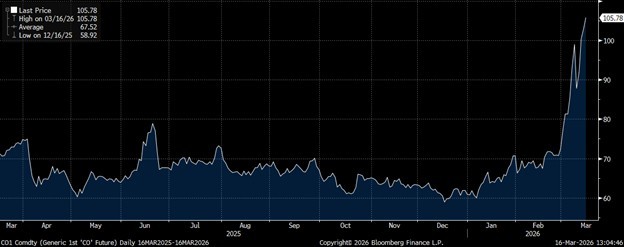
Brent moved back above $100, briefly touching about $119.50 intraday on 9 March. Goldman Sachs meanwhile raised its average March Brent oil forecast to above $100 a barrel. That implies the market is admitting the disruption may last longer than previously anticipated, but it has not yet fully accepted a new regime. Goldman still sees Brent drifting back toward the low $70s later in 2026 if the disruption fades. In other words, the consensus view remains: brutal now, normal later. That confidence in normalisation may underestimate the persistence of the disruption.
Chart 1: Brent Oil Price Spikes Above $100 ($bbl)
Source: Bloomberg
When economists discuss the inflation impact of the rise in oil prices they typically point to 30-40 basis points on headline inflation and reassure markets that core inflation will remain unchanged. Yet sharp increases in fuel and food are not abstract statistical effects. They are felt immediately by households and businesses. What begins as a short-term price spike can quickly become a medium-term problem if energy costs start feeding into broader pricing behaviour.
Markets have been here before. Energy shocks rarely remain confined to energy markets. They tend to migrate quickly into inflation expectations, interest rates and ultimately growth.
The defining shift in the Iranian crisis is that the risk has moved from political theatre to logistical stress.
Markets can absorb rhetoric from either side. They grow anxious when shipping lanes, export hubs and insurance costs are threatened. The ongoing disruption around the Strait of Hormuz is therefore not merely a backdrop to the conflict. It is now the core issue.
Roughly one fifth of global oil consumption, about 20 million barrels per day moves through that narrow waterway. Any prolonged disruption immediately raises questions about the reliability of global energy supply.
President Trump is warning of further strikes around Kharg Island, Iran’s key export hub. The International Energy Agency has described the current episode as the largest oil market disruption on record, with an expected 8 million barrels per day supply drop in March. Reports also point to as much as 10 million barrels per day of cuts in Middle East output.
That is the material shift. Markets are no longer pricing rhetoric. They are beginning to price the possibility of real disruptions to oil flows. The key issue now is not only whether crude prices can spike, but whether elevated levels could persist.
US strikes on Kharg Island have raised the stakes in the region significantly. For now, the attacks appear limited to military installations. But any damage to export infrastructure could materially change the scale of the impact on oil markets. If tanker traffic remains impaired or export terminals become regular targets, markets could reassess energy risk more significantly. That may be an area where market expectations remain relatively relaxed.
Central bank policy now sits awkwardly alongside these developments.
In emerging economies much has changed. The market is now pricing that around half of the world’s central banks could be raising interest rates in the balance of the year. Most of these countries are smaller economies that import energy and therefore face immediate inflation pressure from higher oil prices.
Among the major developed economies, however, the outlook has moderated rather than tightened.
For the Federal Reserve, the market has largely abandoned the expectation of near-term rate cuts. The probability of a September cut has fallen to roughly 40%, and markets now see easing pushed toward the end of the year.
In Europe, the picture is complicated by weak growth. Although the spike in oil prices could lift inflation expectations, the fragile state of the economy will likely prevent the ECB from moving to raise rates. The Bank of England faces a similar dilemma. With growth subdued and inflation risks rising again, the most likely outcome is that the MPC simply holds policy steady rather than moving toward cuts that the market had previously anticipated.
The coming week will bring updates from the Fed, ECB and Bank of England. Those signals are likely to influence fixed income market sentiment in the weeks ahead.
The broader macro backdrop now looks more fragile. The oil shock is not hitting a strong global economy. Europe was already weak. China has struggled to provide sufficient stimulus to offset slowing demand elsewhere. Global manufacturing indicators have been far from convincing. This is not demand-driven reflation. It is conflict-driven energy inflation arriving at a time of uneven growth.
That combination inevitably revives the uncomfortable word economists dislike using: stagflation.
Higher energy costs are again squeezing households whose purchasing power had already been weakened by several years of elevated inflation. That creates pressure for equities and complicates the outlook for bonds. Characterising the current environment solely as a benign commodity upswing may overlook broader macroeconomic dynamics.
Equity markets have begun to recognise this risk. By the end of the week US indices had posted a third consecutive weekly decline, with the S&P 500 falling about 1.6% and the Nasdaq around 1.3%.
The scale of the decline is not particularly alarming. The implication of the move is more important.
Markets appear to be reassessing the implications of higher oil prices beyond the energy sector. They are beginning to recognise that sustained energy inflation compresses broad market equity multiples, squeezes margins and reduces central bank flexibility.
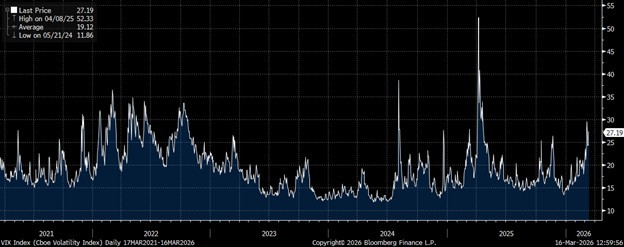
Volatility has increased, although it remains far from crisis territory. The VIX index, a measure of expected volatility in the S&P 500, has moved to around 27. That is elevated but still well below the levels seen during previous major policy shocks.
Chart 2: Equity market Volatility Spikes but Not at Extremes
Source: Bloomberg
Investor behaviour is beginning to reflect the change in mood.
Fund flow data for the week to 11 March showed global equity funds experiencing roughly $7 billion of outflows, the largest since December. US equity funds lost $7.8 billion while European equity funds saw withdrawals of about $7.7 billion. High-yield bond funds suffered $3.2 billion of outflows, the worst week since April 2025.
These figures point less to sector rotation and more to a gradual retreat from risk. Recent fund flow data suggests a shift toward liquidity rather than cyclical positioning.
The stronger dollar reinforces this interpretation. The currency’s rise is not simply a safe-haven response. It reflects tighter financial conditions as higher oil prices reduce expectations for early rate cuts.
That dynamic also explains why gold has not dominated the episode as decisively as might normally occur during geopolitical stress. In a pure war scare gold would typically rally more sharply. In this case the strengthening dollar and rising interest rate expectations complicate the picture. This suggests that geopolitical concerns may be contributing to tighter financial conditions
We all hope that the United States ultimately steps back from this theatre of conflict. War rarely unfolds according to logic. Domestic pressures may yet force President Trump to reconsider the current course. But it remains difficult to determine whether the administration is seeking an off-ramp or preparing for further escalation.
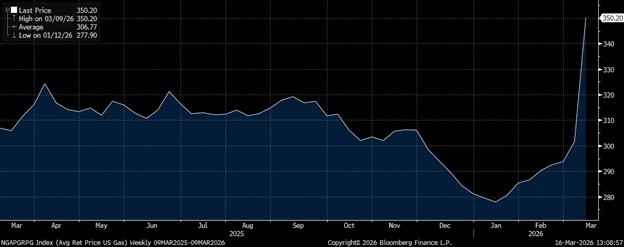
Those who argued that Iran would simply capitulate appear to have underestimated the complexity of the situation. The political pressure point may ultimately be inflation. US gasoline prices have risen nearly 60 cents – roughly 19% – to around $3.54 per gallon nationally, with some reports already pointing closer to $3.63. Historically the political environment becomes far more sensitive once gasoline prices approach the $4 level.
Chart 3: Average Gasoline Price ($/gallon)
Source: Bloomberg
A president under pressure does not always retreat. Sometimes political weakness produces escalation rather than restraint.
In this environment, diversification remains a commonly cited portfolio approach.
Energy equities are sometimes viewed as a hedge against geopolitical risk and sustained oil prices. Some diversified portfolios include commodity exposure, with allocations varying depending on investment objectives and risk tolerance. At the same time market participants may also avoid making large cash allocation changes based solely on geopolitical headlines. Markets have repeatedly underestimated the ability of political actors to step back from escalation.
However, the risks to global growth will rise significantly if the Strait of Hormuz remains constrained for an extended period. Energy disruptions rarely remain confined to the oil market alone. They eventually migrate into inflation, interest rates and economic activity.
The current episode can also be interpreted as a potential energy shock with broader macroeconomic consequences.
Gary Dugan – Investment Committee Member
Bill O’Neill – Non-Executive Director & Investor Committee Chairman
16th March 2026
The information contained within is for educational and informational purposes ONLY. It is not intended nor should it be considered an invitation or inducement to buy or sell a security or securities noted within nor should it be viewed as a communication intended to persuade or incite you to buy or sell security or securities noted within. Any commentary provided is the opinion of the author and should not be considered a personalised recommendation. The information contained within should not be a person’s sole basis for making an investment decision. Please contact your financial professional at Falco Private Wealth before making an investment decision. Falco Private Wealth are Authorised and Regulated by the Financial Conduct Authority. Registered in England: 11073543 at Millhouse, 32-38 East Street, Rochford, Essex SS4 1DB